Informational only, not legal advice. ADU rules change often and differ by city. Confirm with your local planning department before you rely on anything here.
California voters approved two housing measures on November 3, 2026. The Associated Press called both on election night. Prop 37, the California Middle-Class Home Ownership and Family Home Construction Act of 2026, lets the California Housing Finance Agency (CalHFA) borrow up to $25 billion from private investors and lend it to middle-income buyers. Each loan covers up to 17% of the price of a newly built home. Prop 1 (SB 417) is an $11.25 billion general obligation bond for mostly affordable rental housing. For builders of for-sale small-lot homes, SB 9 splits and condo ADUs, Prop 37 matters more: it only finances new homes.
If you plan to build homes for sale, whether that's an SB 684 small-lot subdivision, a new house on an SB 9 split or a condo ADU, your buyer may soon need only 3% down instead of 20%. The 17% gap would be covered by a fixed-rate state second mortgage, as long as the home is new, the buyer is its first owner and the price is under the county cap (about $1.04 million to $1.56 million on 2026 limits). Nothing is available yet. CalHFA has up to a year to launch the program, and its rules will decide the details.
How Prop 37 works: a 17% second mortgage on new homes
Prop 37 adds a new chapter to the Health and Safety Code (Section 51515 and following). From the text and the LAO analysis:
- The money. Up to $25 billion in CalHFA revenue bonds, repaid by buyers' loan payments. The LAO found no direct state or local cost.
- The loan. A "middle-class homeownership loan" is a second mortgage that is subordinate to the buyer's first mortgage and covers up to 17% of the purchase price. It must be fixed-rate with no prepayment penalty.
- The buyer's share. At least 3% of the price, from the buyer's own funds. A grant or borrowed money doesn't count.
- The rate. Not set by the measure. CalHFA sets it at a level that repays the bonds, keeping buyers' costs "as low as possible". Nobody knows it until the first bonds sell.
Prop 37 eligibility: buyers and homes
| Requirement | Rule in the measure |
|---|---|
| Residency | California resident for at least one year before applying |
| Occupancy | Primary residence, moved into within 60 days of closing |
| Income | No more than 200% of area median income for the household size |
| Home type | Newly built house, townhome, row house, condo or manufactured home, or a unit in a converted nonresidential building |
| Sale | The borrower must be the first purchaser |
| Price cap | 125% of the FHFA one-unit conforming loan limit for the county |
On FHFA's 2026 limits ($832,750 baseline, $1,249,125 high-cost ceiling), the cap works out to about $1,040,900 in baseline counties and about $1,561,400 in counties at the ceiling. The limits reset each year. Check your county's figure on FHFA's table before you price a project around it.
What Prop 37 means for SB 684, SB 9 and condo ADU builders
In our for-sale infill projects, the down payment is usually what stops a buyer, not the monthly payment. A $950,000 new townhome needs $190,000 down at 20%. Under Prop 37 the buyer brings $28,500 (3%), CalHFA's second mortgage covers up to $161,500 (17%), and the first mortgage stays at 80%. The buyer pool grows from people with savings to people with income.
The text defines a qualifying home broadly: "a stand-alone home, townhome, or row house … or a condominium, manufactured home, or other residential unit, intended for occupancy by one household." That fits the products California's newer laws create:
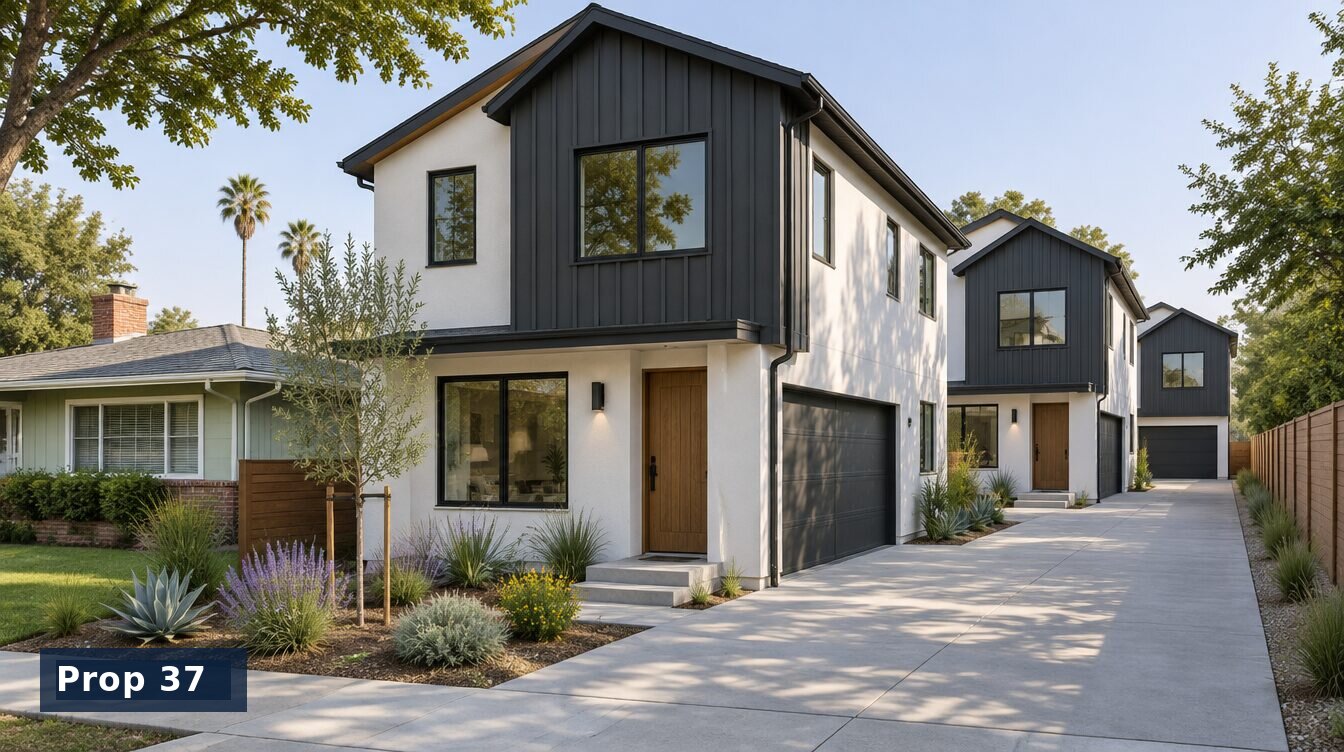
- Small-lot subdivisions. Up to ten fee-simple homes under SB 684 and SB 1123, each sold new to a first buyer.
- SB 9 lot splits. A new house built on the second parcel of an SB 9 urban lot split and sold.
- Condo ADUs. In cities that have opted into AB 1033, a newly built ADU sold as a separate condo to its first buyer. The ADU has to be the buyer's home, so investor purchases don't qualify.
A high-cost coastal lot can price a project over the cap, and CalHFA's rules can still tighten eligibility. This is our reading of the statute, not legal advice; confirm program terms with CalHFA and a lender before you underwrite a sale on them.
The qualified builder option
Any builder's new homes can be sold to Prop 37 buyers. A builder may also opt in as a "qualified builder": higher labor standards in exchange for friendlier construction-defect procedures. On a five-home SB 684 project the labor terms may cost more than that relief saves, so price both first.
Prop 1 housing bond: where the $11.25 billion goes
Prop 1 is the Veterans and Affordable Housing Bond Act of 2026, placed on the ballot by SB 417 (Chapter 16, Statutes of 2026). It combines a $10 billion general obligation bond with $1.25 billion for CalVet home loans. The LAO estimates repayment at $500 million to $600 million a year for about 25 years. Per the LAO:
- $7.2 billion for affordable multifamily programs, including $5.1 billion for HCD's Multifamily Housing Program and $1.15 billion for supportive housing.
- $1.1 billion for homeownership, including $600 million for CalHome, which can fund single-family subdivisions.
When Prop 37 takes effect, and what to do now
Counties are still counting. Under Article II, Section 10 of the California Constitution, an initiative statute takes effect five days after the Secretary of State files the statement of the vote. CalHFA then has up to a year to launch the program. Our recommendation:
- If you're entitling for-sale homes now, design some units to land under your county's cap.
- Leave Prop 37 buyers out of your pro forma until CalHFA publishes a rate. Treat them as upside.
- Watch FHFA's 2027 conforming loan limits, which reset the cap.
To check what your lot can hold, start with our construction cost guide, then run the address in Parcy.
Frequently asked questions
What does Prop 37 do in California?
It lets CalHFA sell up to $25 billion in revenue bonds and lend the money to middle-income buyers as a fixed-rate second mortgage covering up to 17% of the price of a newly built home. The buyer puts at least 3% down from their own funds.
Who qualifies for a Prop 37 middle-class homeownership loan?
A one-year California resident earning no more than 200% of area median income who moves in within 60 days and is the first buyer of a qualified new home under the county price cap.
What is the Prop 37 price limit?
125% of the FHFA one-unit conforming loan limit for the county: about $1.04 million to $1.56 million on the 2026 limits, adjusted every year.
Can an SB 684 or SB 9 home be bought with a Prop 37 loan?
It appears so: the text covers any newly built home, townhome, condo or manufactured home sold to its first purchaser. CalHFA still has to write the program rules.
Official bill text
- SB 417 — The Veterans and Affordable Housing Bond Act of 2026. (official bill text, California Legislative Information)
Sources
- Legislative Analyst's Office: Proposition 37 analysis (November 3, 2026 ballot) — Up to $25 billion in CalHFA revenue bonds, 17% loans, 3% buyer down payment, qualified builder option, no direct state cost
- Secretary of State: Text of Proposed Laws, November 3, 2026 (Props 1 and 37) — Prop 37 adds Health and Safety Code § 51515 et seq.; Prop 1 is SB 417, Chapter 16, Statutes of 2026
- Legislative Analyst's Office: Proposition 1 analysis (November 3, 2026 ballot) — $11.25 billion; $500–600 million a year for about 25 years
- FHFA: Conforming loan limit values for 2026 — $832,750 baseline, $1,249,125 high-cost ceiling for one-unit homes
- CalMatters: California decides on housing bonds with Prop 1 and Prop 37 — AP called both measures on election night, November 3, 2026
- California Constitution, Article II, Section 10 — When an initiative statute takes effect
- Prop 37
- Prop 37 California 2026
- middle-class homeownership loan
- CalHFA down payment assistance new homes
- Prop 37 price limit
- Prop 1 housing bond
- SB 684 small lot homes financing
- new construction down payment California
Stay ahead of the next ADU bill.
New California housing bills, what they mean for your lot, and news from Parcy and Kaz Capital Group. A few emails a month.
Informational only. Not legal, architectural, or investment advice. Confirm current rules with your local planning department.