Informational only, not legal advice. ADU rules change often and differ by city. Confirm with your local planning department before you rely on anything here.
AB 1751, the Missing Middle Townhome Ownership Act by Assemblymember Sharon Quirk-Silva (D-Fullerton), was approved by Governor Newsom on September 29, 2026 and chaptered as Chapter 781, Statutes of 2026. It passed the Senate 36-2 and the Assembly concurred 60-0, both on August 26, 2026. From January 1, 2027, a city or county must approve a qualifying for-sale townhome project of up to 150 homes, and its subdivision map, ministerially: no discretionary review, no hearing, and no CEQA.
If you own a multifamily-zoned lot, or a single-family lot with no house on it (or only an abandoned, uninhabitable one), and it sits outside fire, flood and SB 79 transit zones, you can file for up to 150 townhomes on their own lots and the city has to treat it as a checklist, not a vote. The trade: every home must be a townhome of three stories or fewer, the project has to reach 75% of your city's housing-element default density, and projects of 11 or more homes set aside 10% for lower-income buyers. Not legal advice; a land-use attorney should confirm eligibility for your parcel.
What AB 1751 allows
The bill adds Government Code section 65852.30 and a new Subdivision Map Act chapter starting at section 66499.45. Together they cover both the buildings and the map. A "townhome development project" must:
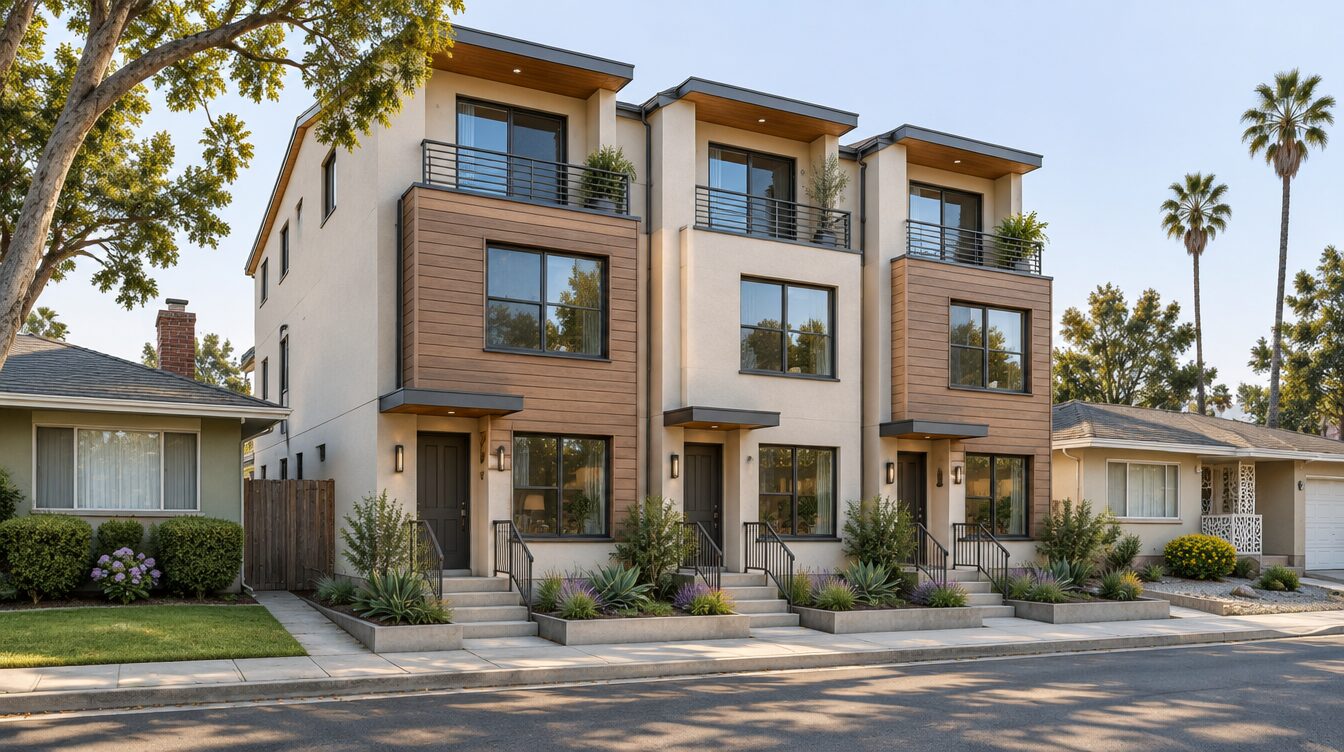
- Consist entirely of townhomes: single-family homes of no more than three stories of occupiable space that share a wall on one or two sides, or sit no farther apart than the building code's minimum fire separation.
- Average no more than 1,750 net habitable square feet per home. Garages, carports, cellars and unfinished attics or basements don't count.
- Contain no more than 150 units.
- Reach at least 75% of the default density in Government Code section 65583.2(c)(3)(B), the "Mullin" density used in housing elements. In a metropolitan jurisdiction that default is 30 units per acre, so the floor is about 22.5 units per acre; suburban jurisdictions use 20. Check which category your city falls into.
- If it has 11 or more homes, dedicate at least 10% to lower-income households at an affordable housing cost for at least 45 years, or meet the local inclusionary rule if that is higher.
New parcels can be as small as 600 square feet, with no extra width, depth or frontage minimums. Homes can be fee-simple lots, a common interest development, a co-op, land trust homes or a tenancy in common, and a city cannot force an HOA beyond what Davis-Stirling requires.
Which sites qualify for ministerial townhome approval
Two kinds of land qualify: a lot zoned for multifamily use, or an "underutilized" lot zoned only for single-family homes. Underutilized means no permanent residential structure, unless it is abandoned and uninhabitable. Housing with an affordability covenant or rent control never counts as underutilized.
The exclusions decide most sites:
- San Francisco, by name.
- Any site where SB 79 transit-oriented housing is an allowed use.
- High or very high fire hazard zones, farmland, wetlands, habitat, historic resources, and flood or fault zones unless the project meets the federal or seismic standards.
- Sites the housing element counts toward the lower-income RHNA, and zones whose minimum density is above 50 units per acre.
- Lots that had five or more units in the last five years, an Ellis Act withdrawal in the last 15, or protected housing that would be torn down.
Outside a Census urban area the lot must also be infill, with developed parcels on at least three sides, and every new parcel needs a community water system and municipal sewer.
What the city can still require
The city keeps its objective standards: written, measurable zoning, subdivision and design rules. It cannot use them to physically block a project at 75% of the default density, cannot add rules just because a project uses AB 1751, and cannot require covered or enclosed parking. It can still require general-plan street and utility improvements. A denial needs a written finding, by a preponderance of the evidence, of a specific, adverse impact on public health and safety that can't be mitigated, the same high bar as the Housing Accountability Act.
Tribal consultation still applies, so build it into the schedule. And parcels generally cannot be sold or financed separately until each has a finished home, unless the city waives that. Plan your construction loan around it.
One thing that changed late: April through June 2026 versions of the bill set a $28-per-hour minimum wage for carpentry work. The chaptered text has no wage or workforce requirement.
AB 1751 vs SB 684: which townhome path fits your lot
| SB 684 / SB 1123 | AB 1751 | |
|---|---|---|
| Max homes | 10 | 150 |
| Site size cap | Yes (1.5 acres for vacant single-family lots) | None |
| Building type | Any home type | Townhomes, 3 stories max |
| Minimum density | Set by SB 684 (revised by SB 1116 for 2027) | 75% of default density |
| Affordable set-aside | Local inclusionary only | 10% lower-income at 11+ homes |
| Min. parcel | 600 sq ft (1,200 single-family) | 600 sq ft |
For a quarter-acre lot, our SB 684 and SB 1123 guide is still the place to start, and SB 1116 loosens those rules again for applications filed from January 1, 2027. AB 1751 earns its keep on larger sites: a one- to five-acre multifamily parcel, or a vacant single-family site, where ten homes leaves land on the table. On a lot that already has a house, look at SB 9 or ADUs instead; AB 1751 also lets a city refuse an SB 9 lot split on parcels it creates.
Our take
This is a for-sale pathway. It works where townhomes sell for well above build cost, and the 10% affordable set-aside on 11+ homes is a real cost to underwrite. On a metro site the 75% floor means roughly 22 homes an acre: narrow three-story plans with tuck-under garages. Cities may adopt implementing ordinances, so check your city's planning page for an AB 1751 ordinance before you design. Send us the parcel and we'll tell you whether AB 1751, SB 684 or ADUs pencil best.
Frequently asked questions
What is the Missing Middle Townhome Ownership Act?
It is AB 1751 (Quirk-Silva), signed September 29, 2026. From January 1, 2027, qualifying townhome projects of up to 150 units, and their maps, get ministerial approval with no hearing and no CEQA review.
Can I build townhomes on a single-family lot under AB 1751?
Only if the lot is underutilized, meaning it has no permanent home on it or the home is abandoned and uninhabitable. Lots with an occupied house, rent-controlled or deed-restricted housing do not qualify under the single-family branch; multifamily-zoned lots qualify regardless.
How is AB 1751 different from SB 684?
SB 684 and SB 1123 cap a project at 10 homes. AB 1751 allows up to 150 townhomes with no site-size cap, but requires three-story-max townhomes, 75% of the default density, and 10% lower-income homes in projects of 11 or more.
Does AB 1751 apply in San Francisco or near transit?
No. San Francisco is excluded by name, and sites where SB 79 transit-oriented housing is an allowed use are excluded too.
Does AB 1751 require prevailing wage?
The chaptered text has no prevailing-wage or skilled-and-trained workforce requirement. A $28-per-hour carpentry wage floor appeared in April through June 2026 drafts but was removed before final passage.
Official bill text
- AB 1751 — Missing Middle Townhome Ownership Act. (official bill text, California Legislative Information)
- SB 1116 — Planning and zoning: housing development projects: subdivisions. (official bill text, California Legislative Information)
Sources
- AB 1751 (2025-26): status, votes and chaptered text — Approved by the Governor September 29, 2026; Chapter 781, Statutes of 2026; Senate 36-2 and Assembly concurrence 60-0 on August 26, 2026
- Governor Newsom signs housing legislation (September 29, 2026) — Signing release listing AB 1751 by Assemblymember Sharon Quirk-Silva
- Holland & Knight: California Enacts AB 1751 (October 2026) — Law-firm summary; effective January 1, 2027
- Brownstein: California enacts another wave of 2026 housing bills — AB 1751 compared with the Starter Home Revitalization Act (SB 684)
- AB 1751
- Missing Middle Townhome Ownership Act
- California townhome law 2027
- by-right townhomes California
- ministerial townhome subdivision
- AB 1751 vs SB 684
- build townhomes on single-family lot
- Quirk-Silva townhome bill
- California missing middle housing
Stay ahead of the next ADU bill.
New California housing bills, what they mean for your lot, and news from Parcy and Kaz Capital Group. A few emails a month.
Informational only. Not legal, architectural, or investment advice. Confirm current rules with your local planning department.